Putt Golf
- 4.0
- Rating
- 10.00K
- Installs
- Free
- Price

 Analysis by App-foxy
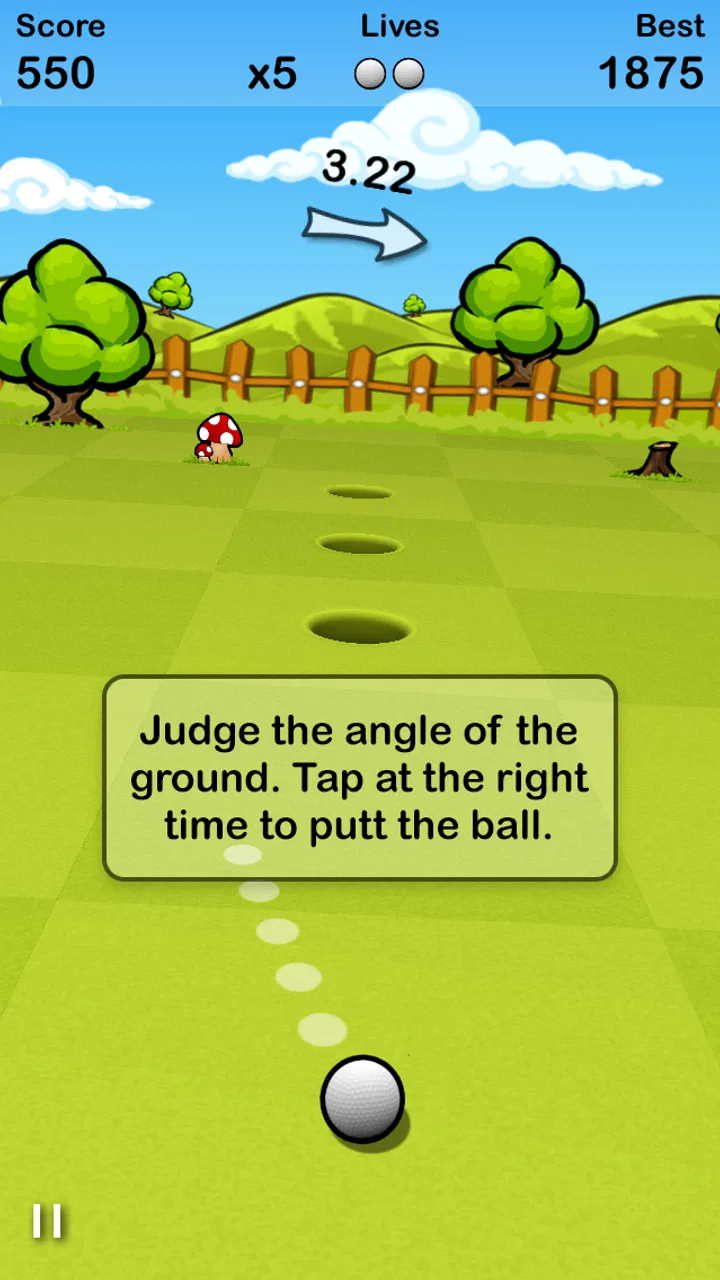
I usually turn to a golf game when I want something quieter than a racing game but more focused than a completely idle pastime. Putt Golf fits that narrow space well. It is a free sports game from EivaaGames built around a very small action: read the slope of the ground, judge the angle, and tap when the ball should roll toward the hole. That sounds simple, and the first few attempts are simple, but the appeal comes from how much attention a tiny putting surface can demand.
After spending time with it, I see the game as a compact test of observation and timing rather than a full golf simulation. You are not managing a complete round, choosing clubs, or learning a large control system. Instead, each putt asks you to pause, inspect the surface, and commit to one touch. That makes it easy to pick up in a spare moment, while also giving accurate players a reason to replay a difficult attempt.
The game is listed for Everyone, so its basic idea is approachable for younger players as well as adults. It is free to start, with optional in-app purchases priced at $2.99 per item. The current version is 1.85, and it runs on devices using Android 5.1 or later. Those details make it a practical choice for someone with an older compatible phone who wants a lightweight game rather than a demanding modern sports package.
You May Also Like

 Blood Strike: 2.5 Anniversary
Blood Strike’s Loadouts Turn Every Drop Into a Tactical Gamble
A close look at Blood Strike’s custom loadouts: how fast access to signature weapons reshapes its battle royale rhythm, rewards preparation, and narrows the gap between fights.

 Pandora - Music & Podcasts
Pandora’s Music Is Easy to Start, but Harder to Recover
Pandora’s strength is its low-effort path from a seed to a station. Its weak spot is how much confidence it asks you to place in connection, setup, and quiet recovery.

 8 Ball Pool
 Is Built on Rivalries, Rematches, and Routine
A close look at the rivalries, rematches, shared routines, and unanswered safety questions that turn a quick pool match into a persistent mobile community.

 Samsung Music
’s Quiet Strength Is Playing What You Already Own
Its reach comes less from spectacle than from dependable access to a personal library. That simplicity is both the app’s strongest retention engine and its ceiling.

 AccuWeather: Weather Radar
AccuWeather Review: A Quick, Clear Forecast for Everyday Decisions
For everyday plans, the best forecast is the one you can understand quickly. AccuWeather makes rain timing, radar, and local conditions easy to act on, with a few trade-offs.

 Hill Climb Racing
Why Hill Climb Racing Still Turns Crashes Into One More Run
A tiny car, a bumpy hill and one more upgrade: Hill Climb Racing keeps resurfacing because its simple chaos makes every near-miss feel personal.
More From Our News Desk



How the first few putts create a clear goal
The opening goal is immediately understandable: get the ball into the hole with a well-timed tap. I like that there is no long explanation needed before playing. The surface itself becomes the tutorial. If the ball bends away from the target, I can connect the result to my reading of the ground; if it stops short, I know my timing or judgment was too cautious.
That direct feedback gives the early game a pleasant rhythm. I am not learning a collection of buttons first. I am learning to look. The important question is not simply where the hole sits, but how the ground changes the ball’s path. This makes the earliest goals feel fair because improvement comes from paying closer attention rather than memorizing an elaborate control scheme.
For a casual player, this is a useful design choice. I can hand the game to someone who rarely plays mobile sports games and explain the central action in a few seconds. The challenge does not come from hidden controls. It comes from making a decision with limited room for correction once the ball is moving.
The trade-off is that the early experience may feel too narrow for anyone expecting a conventional golf game. There is no sense here of building a golfer, managing a bag of clubs, or planning a full course strategy. If your personal goal is to experience golf as a broad sport, this will feel more like a focused putting exercise. If your goal is to solve short visual challenges, the limited scope becomes a strength.
Why observation matters more than fast tapping
The most useful habit I developed was waiting before touching the screen. My first instinct was to tap quickly and trust the obvious direction, but the game rewards a slower inspection. I now treat each attempt as a small reading exercise: identify the hole, estimate the ground’s angle, decide how much the surface may redirect the ball, and only then make the input.
That pause also helps separate two different mistakes. A ball that travels along the wrong line suggests that my angle was poor. A ball that follows the right general line but fails to reach the hole points more toward timing or force. Learning to distinguish those outcomes makes retries more productive. Instead of tapping randomly, I can adjust one part of the decision at a time.
This is one of the game’s less obvious strengths. Its simplicity leaves room for self-correction. A larger golf title may offer more information, but that can sometimes hide the reason for a failed shot behind statistics, equipment choices, or complicated controls. Here, the mistake is exposed in the path of the ball.
Progress feels personal rather than heavily explained
The progress signal I notice most is my own consistency. A successful putt is satisfying, but the more meaningful improvement is being able to read a similar slope correctly on the next attempt. The game does not need a large reward screen to show that I am getting better; fewer careless misses are already a clear sign.
That approach suits short sessions. I can play for a few minutes, stop, and return later without needing to remember a complicated storyline or a long list of objectives. The mental progress carries over naturally. I remember that I previously underestimated a break or tapped too early, and I approach the next challenge with a more useful plan.
Players who need frequent unlocks, character upgrades, or visible collections may find this progress less exciting. The satisfaction is tied to execution, not to accumulating a large set of virtual possessions. In my view, that makes the game cleaner, but it also limits its appeal as a long-term progression game for people who want constant external rewards.
Because the central interaction is so small, the game’s pacing depends heavily on how much variety and challenge the individual situations provide. I would not choose it for a long uninterrupted gaming session every day. I would choose it when I want repeated, self-contained attempts where each one asks for a little concentration.
Difficulty, pacing, and the pressure to keep playing
The difficulty curve works best when I stop treating every putt as a reflex challenge. The early situations invite confidence, but later attempts demand more careful judgment because the ground angle becomes the main obstacle. Even without a large control set, the game can make a familiar action feel different when the path is less forgiving.
My practical advice is to avoid changing several things after a miss. If the ball curved correctly but stopped before the hole, keep the angle and adjust the timing. If it passed to one side, reconsider the line before changing how quickly you tap. This method turns the game into a small experiment and prevents frustration from becoming a series of unplanned guesses.
There is also a useful pacing advantage in the one-touch structure. A round does not require a long setup, and a failed attempt does not leave me managing a complicated aftermath. That makes the game suitable for a commute, a short break, or a few minutes while waiting for an appointment. The best everyday scenario is probably someone sitting down with a phone, playing several focused attempts, then putting it away without losing progress in a larger session.
At the same time, the short format can expose repetition. Players who want dramatic presentation, live competition, or a strong sense of place may find the experience restrained. A full golf alternative usually offers more context and more ways to influence a shot. Putt Golf is better compared with a pocket puzzle than with a complete console-style golf simulation.
Where the challenge is satisfying and where it becomes limiting
The satisfying part of the challenge is that the screen asks me to make a judgment, not merely react. I can improve by studying the ground and remembering how the ball behaved. That gives misses a constructive quality. I often feel that the next attempt is worth making because I have learned something specific.
The limitation is that the same narrow focus may not provide enough variety for every player. If you enjoy golf because of club selection, wind, distance management, or tournament planning, this game does not replace those experiences. It also may not suit someone looking for a relaxed game with almost no failure. The requirement to judge the angle means that casual play still asks for attention.
For children, the Everyone rating makes the concept approachable, but younger players may need help understanding why a visually direct shot does not travel straight. That can actually become a useful introduction to the idea that surfaces affect movement. For adults, the same lesson is presented without turning the game into a technical physics exercise.
Free access and the question of retention
Being free to download lowers the barrier to trying it. I can test the putting idea without committing money first, which is important for a game with such a focused premise. The optional purchases at $2.99 per item are worth considering before treating it as a completely cost-free experience, especially if you are sensitive to spending inside games.
I do not think the game’s strongest reason to retain players is a heavy reward loop. Its pull comes from wanting to correct a miss, beat a tricky situation, or prove that a better reading produces a better result. That is a healthier kind of pressure for me because it comes from the play itself rather than from feeling forced to maintain a streak or chase a fictional collection.
Still, this retention style is selective. I can imagine playing regularly if I enjoy precision challenges, but I would not promise that everyone will stay engaged for weeks. Someone who needs a steady stream of new mechanics may move on sooner. In contrast, a player who likes repeating a compact task until it feels mastered may find the simplicity surprisingly durable.
One good way to use it is as a reset between demanding tasks. Rather than opening a game that requires remembering a story or managing several menus, I can play a few putts and focus on one decision at a time. That makes it a better companion for short breaks than for a planned evening of deep gaming.
How it compares with other mobile golf choices
Compared with larger golf games on Android or iOS, this one is much more concentrated. The usual alternatives may offer broader courses, more equipment, stronger visual presentation, or a multiplayer structure. Those features can make them more exciting when I want a complete sports package, but they also bring more menus, longer sessions, and more systems to learn.
Compared with a general puzzle game, Putt Golf has a more recognizable physical objective. The ball’s movement gives each attempt a concrete result, and the golf framing makes the challenge easy to understand. It is a good middle ground for someone who likes logic but wants the answer to be expressed through a shot rather than a matching board or word problem.
My choice would depend on the session I want. I would select a larger golf game for variety, competition, or a sense of building a career. I would select this one for immediate play, simple controls, and the satisfaction of improving a judgment-based skill. Neither approach is automatically better; they serve different moods.
The developer, EivaaGames, has positioned the experience around the essential act of putting rather than surrounding it with a broad simulation. That focus is exactly why it can work on an older compatible device and why it is easy to recommend to someone who dislikes complicated mobile interfaces. It is also the reason I would explain its limits before recommending it to a dedicated golf fan.
Who should try it and who should skip it
I would recommend it to players who enjoy short challenges, visual judgment, and retrying a shot with a small adjustment. It is particularly suitable for someone who wants a free sports game that can be understood immediately and played in brief sessions. The Everyone age rating also makes it a reasonable family-friendly option when the player is comfortable with the optional purchase model.
I would skip it if I wanted a realistic golf career, a large equipment system, or a competitive social experience. I would also skip it if repeated precision attempts feel stressful rather than satisfying. The game does not disguise its central idea, so there is little reason to expect it to become a different kind of sports title after a few minutes.
Before installing, I would check that the device uses Android 5.1 or newer. The game is free, so trying it is straightforward, but I would still keep the optional $2.99 purchases in mind when deciding whether it fits my spending preferences. Its average rating is 4.0 from around 135 ratings, with about 26 written reviews, and it has passed 10 thousand installs, which suggests a modest but established audience rather than a huge mainstream player base.
My progression verdict
As a progression-focused game, Putt Golf is modest but coherent. Its early goal is clear, its progress signal is the improvement of my own reading, and its difficulty grows through less forgiving putting decisions rather than through a pile of unrelated mechanics. The pacing is strongest in short sessions, where each attempt feels complete and easy to understand.
Its retention depends on whether I enjoy mastery more than collection. I keep returning when I want to correct a specific mistake or see whether a more careful angle works. I am less likely to continue when I want constant unlocks, narrative rewards, or a broader simulation of golf.
My final view is positive, with a clear qualification: this is a focused putting game, not a full golf substitute. I would recommend it to a friend who wants a simple sports challenge that rewards patience and observation. I would describe it as a good pocket-sized test of timing, while making sure they understand that its narrow design is both its main strength and its main limitation.
FAQs for Putt Golf
01What is Putt Golf, and how does the game work?
Putt Golf is a casual mini-golf game focused on completing putting challenges across a variety of courses. Players aim, adjust the strength of each shot, and try to reach the hole in as few strokes as possible. The controls are generally easy to understand, making it suitable for quick sessions, although mastering angles, obstacles, and power takes practice.
02Is Putt Golf free to download and play?
Putt Golf can generally be downloaded and played without an upfront purchase, but the exact monetization model may depend on the version available for your device and region. Free games may include advertising, optional purchases, or unlockable content. Before downloading, it is worth checking the store listing for details about ads, in-app purchases, and any premium features.
03Does Putt Golf require an internet connection?
The basic putting gameplay may be available without a constant internet connection, which makes Putt Golf convenient for short offline sessions. However, certain features can require access to the internet, including advertisements, online leaderboards, cloud-related services, updates, or purchases. If offline play is important to you, test the main courses after installation and review the developer’s current requirements.
04Is Putt Golf suitable for children and beginners?
Putt Golf is generally approachable for beginners because its main objective is simple: guide the ball into the hole using timing, direction, and shot strength. Younger players can usually understand the basic controls quickly, but parents should still review the app’s content rating, advertising, and purchase options. Difficulty may increase as courses introduce more obstacles and complicated layouts.
05What devices are compatible with Putt Golf, and does it perform well?
Compatibility depends on the specific Putt Golf release, operating system version, and device hardware. It should run best on relatively recent Android phones, iPhones, and tablets that meet the requirements shown on the official app store page. On older devices, players may experience slower loading, reduced visual quality, or occasional performance issues, so checking the listed requirements before downloading is recommended.
Pros
- Simple controls make it easy for beginners to start playing.
- Short holes are convenient for quick games during spare moments.
- Colorful courses give the game a cheerful
- casual atmosphere.
- Progression encourages players to replay levels and improve their scores.
- The miniature-golf format works well for both relaxed and competitive play.
Cons
- Later courses may feel repetitive if you play for long sessions.
- Some shots require precise timing that can feel frustrating on mobile.
- Limited depth may disappoint players seeking a realistic golf simulation.
- Ads or optional purchases may interrupt the otherwise quick gameplay.
- Performance can vary on older phones
- especially on visually busier courses.

Putt Golf
Gallery